Case Study· 2025-2026

Dealer Sales Workspace

Field research and product strategy for an agentic, CRM-integrated sales workspace that turns showroom conversations into closed deals.

Client
White-labeled — confidential enterprise client (under NDA)
Category
UX Research · Product Strategy · B2B · Agentic Systems
Year
2025-2026
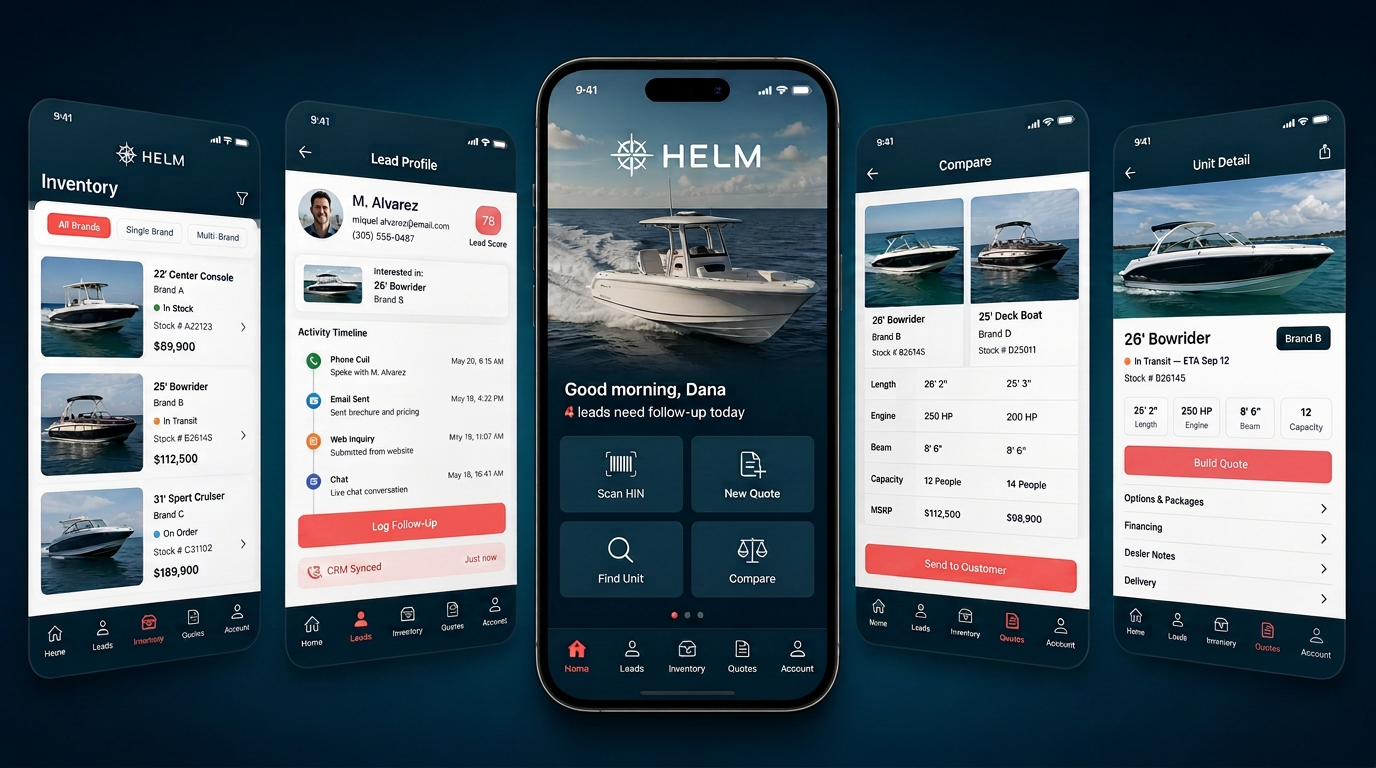
Five HELM dealer sales workspace screens fanned on a deep navy-teal gradient — a center iPhone showing the Home dashboard, flanked by frameless Inventory (single-brand and multi-brand filters), Lead Profile, Compare, and Unit Detail screens.
01

The problem

Sales reps and dealers were juggling disconnected apps, PDFs, spreadsheets, and portals to answer basic questions on the showroom floor. Research showed that buyers arrive after 18 months and 100–200 hours of personal research, educated and largely decided. The sales conversation had to respect their preparation, not restart it. The business opportunity was to consolidate the rep workflow into one fast, accurate, CRM-integrated conversion tool — and extend it with an agentic layer that could connect custom CRM, lead, pricing, catalog, scheduling, and inventory systems so dealers could respond to already-educated buyers without manual handoffs or data re-entry.

02

My role

Lead UX Research & Product Strategy

  • Led Dealer Insights, Consumer Insights, and User Research across multiple regions to uncover the real workflows and motivations of both dealers and buyers.
  • Synthesized research into five buyer personas and a clear Jobs-to-be-Done spine that shaped the product strategy.
  • Defined the product around two daily rep flows — spec lookup and lead capture — integrated with existing CRM and lead management systems.
  • Proposed an agentic integration layer using MCP (Model Context Protocol) principles so dealers could connect their own CRM, leads, pricing, catalogs, scheduling, and inventory into a unified, automated selling experience.
  • Designed the agentic workflow to convert sales sooner and faster: a buyer's self-service research could surface as a qualified lead, matched to available inventory, local promotions, and a rep's calendar before the conversation even started.
  • Prototyped and tested with reps in their own environments before code shipped, then co-authored a rollout playbook with sales leadership.
  • Scoped permissions, brand variants, and offline behavior so the tool works in showrooms, on docks, and at boat shows.
03

Process

  1. Step 01

    Field Research

    Multi-region interviews, contextual inquiry on the showroom floor, and diary studies mapped the real rep workflow and the apps, spreadsheets, and handoffs they actually use.

  2. Step 02

    Consumer Insight

    Research showed buyers arrive after 18 months and 100–200 hours of research. They expect accuracy, speed, and respect for the work they have already done.

  3. Step 03

    Workspace Strategy

    Consolidated 14+ tools into a single CRM-integrated surface focused on spec lookup, lead capture, and post-sale follow-through.

  4. Step 04

    Agentic & MCP Integration

    Designed an agentic integration layer using MCP (Model Context Protocol) principles so dealers could connect custom CRM, lead, pricing, catalog, scheduling, and inventory systems into a single automated experience that converts sales sooner and faster.

03.5

Personas we designed for

Family Boaters

Weekend memories, safety first

Motivations
  • Create shared experiences with kids, extended family, and friends.
  • Feel confident the boat is safe, comfortable, and easy to operate on their own.
  • Protect the investment — they're buying a lifestyle, not a toy.
Needs
  • Clear comparison of seating capacity, storage, and safety features.
  • Financing scenarios that show the true monthly cost of ownership.
  • A rep who understands weekend use cases, not just spec sheets.
In-app messaging
  • "Built for the whole crew — see layouts by group size."
  • "Estimate your monthly with insurance, slip, and service included."
  • "Compare safety packages side-by-side."
First-Time Boaters

Educated online, nervous in person

Motivations
  • Finally act on months (or years) of research and forum reading.
  • Avoid feeling talked-down-to or upsold on the showroom floor.
  • Validate that the boat they've picked online is actually right for them.
Needs
  • Plain-language explanations of hull types, engine options, and trailering.
  • A guided next-step path: sea trial, financing, delivery, training.
  • Transparent pricing that matches what they saw online.
In-app messaging
  • "New to boating? Start here." (guided walkthrough)
  • "Same price you saw online — no surprises."
  • "Book a captained sea trial before you decide."

Generational Boaters

Loyal to brand, upgrading again

Motivations
  • Stay with a brand and dealer they've trusted for decades.
  • Upgrade to the next size, new features, or a second boat.
  • Be recognized for their loyalty and history with the dealer.
Needs
  • Ownership history and past-boat details surfaced automatically at check-in.
  • Trade-in valuation tied to what they actually own today.
  • Fast access to what's new versus their current model.
In-app messaging
  • "Welcome back, [Name] — here's what's new since your last boat."
  • "Trade-in estimate for your 2019 [model] — updated today."
  • "Priority sea trial slot reserved for returning owners."

DIY Boaters

Hands-on, spec-driven, self-serve

Motivations
  • Understand the boat down to the component level — engines, wiring, systems.
  • Own the maintenance and customization themselves.
  • Be treated as a peer, not a lead to be qualified.
Needs
  • Deep spec sheets, parts diagrams, and service manuals in-app.
  • Straight answers about aftermarket compatibility and warranty impact.
  • Minimal sales friction — let them build and price the config themselves.
In-app messaging
  • "Full spec sheet + parts catalog — no signup required."
  • "Build and price your rig, then send it to a rep when you're ready."
  • "Warranty-safe upgrade paths."

VIP Collectors

White-glove, discreet, expedited

Motivations
  • Add to a collection or replace a flagship with the newest model.
  • Be handled personally, privately, and without standard sales scripts.
  • Move fast — decisions are already made, execution is what matters.
Needs
  • A named concierge rep with full history and preferences on tap.
  • Off-hours access, private viewings, and expedited delivery/customization.
  • Discreet handling of pricing, trade-ins, and payment.
In-app messaging
  • "Your concierge, [Rep Name], is standing by."
  • "Private viewing available — schedule off-hours."
  • "Expedited build slot reserved for you."
05

In the wild

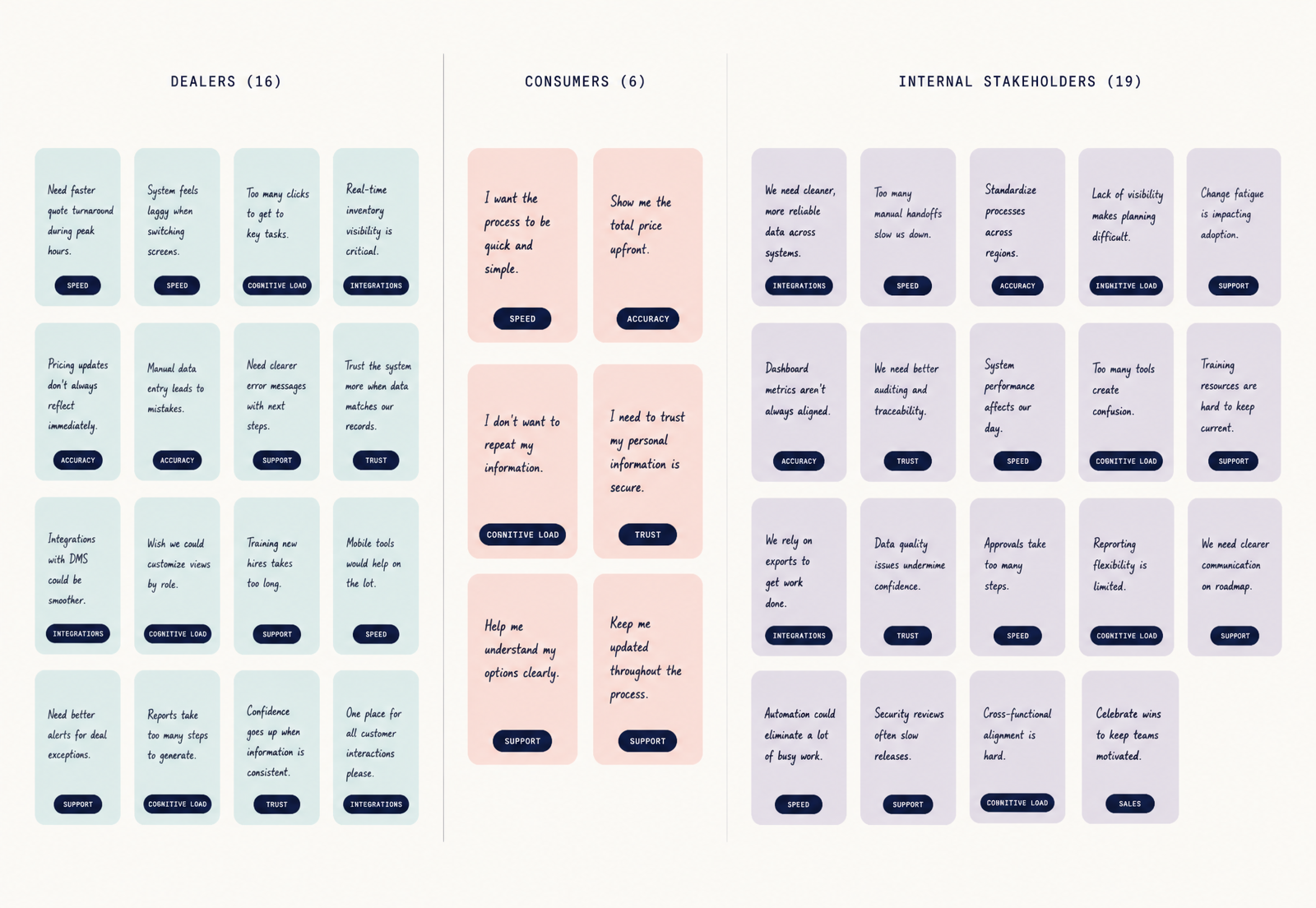
Synthesized affinity themes across Dealers, Consumers, and Internal Stakeholders tagged with Speed, Accuracy, Integrations, Trust, Support, Cognitive Load, and Sales.
Synthesis — 41 raw insights tagged into seven recurring themes.
04

Measurable results

18 mo → days
Compress the buyer-to-dealer research gap by surfacing qualified leads as soon as intent is detected
~24 hr → <1 hr
Projected reduction in time-to-first-touch when inbound intent auto-routes to the right rep
30–45%
Projected shorter time-to-close by removing manual lookups, re-entry, and cross-system handoffs
14+ → one
Sales tools consolidated into a single CRM-integrated, agent-orchestrated surface
5 personas
Family, first-time, generational, DIY, and VIP collectors informing the agent's matching logic
The workspace only earned its second visit because we designed for the workflow reps actually had and the buyers they actually serve. Field research turned a skeptical audience into daily users. The agentic layer was the natural next step: buyers already do the research; the system should do the connection.
Strategic extension

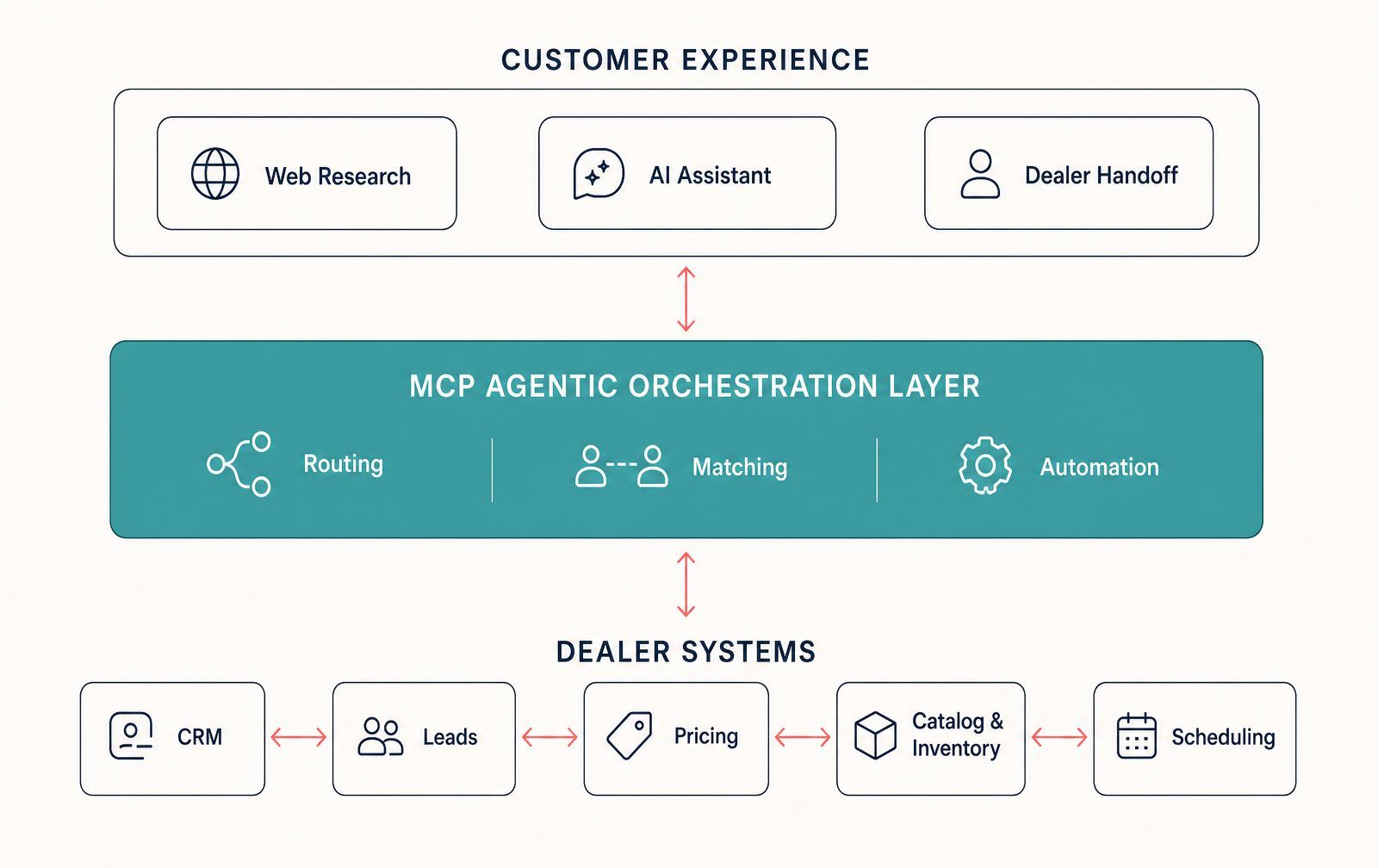
Agentic integration for a connected dealer experience

Because buyers arrive after 18 months and 100–200 hours of independent research, the dealer's job is no longer to educate — it is to confirm, configure, and close. An agentic integration layer, designed around MCP (Model Context Protocol) principles, would let dealers connect their own CRM, lead, pricing, catalog, scheduling, and inventory systems into a single automated workflow that converts sales sooner and faster.

Architecture diagram showing three layers: Customer Experience (Web Research, AI Assistant, Dealer Handoff) at the top, a teal MCP Agentic Orchestration Layer in the middle handling routing, matching, and automation, and Dealer Systems (CRM, Leads, Pricing, Catalog & Inventory, Scheduling) at the bottom, connected by bidirectional coral arrows.
Architecture — the MCP agentic layer sits between the customer experience and the dealer's existing systems, orchestrating data flow in both directions without replacing any tool the dealer already trusts.
Research synthesis

What the field research surfaced

We clustered 41 quotes from dealers, consumers, and internal stakeholders around three drivers that pointed directly at the product spine.

Efficiency

Reps need quick, accurate data without losing eye contact with the buyer.

Trust

Buyers arrive educated and expect transparent, no-pressure expertise.

Integrations

One source of truth for specs, pricing, media, and CRM lead capture.

Agentic opportunity

How MCP-style integration could connect the dealer stack

Dealers use a patchwork of custom systems. An MCP-style agentic layer would let each dealer keep their own tools while the workspace acts as the orchestration surface.

CRM & lead context

Inbound leads, ownership history, and engagement signals flow into the workspace so the rep knows the buyer's journey before the handshake.

Pricing & promotions

Real-time pricing, regional incentives, and trade-in estimates surface automatically during the conversation.

Catalog & inventory

Available models, configurations, and compatible accessories are matched to the buyer's stated needs without switching systems.

Scheduling & follow-through

Sea trials, delivery windows, and service appointments can be booked or queued from the same surface that captured the lead.

Dealer workflow

How a dealer uses MCP to run one automated sales process

Instead of switching between 14+ tools, the rep works from a single surface. The MCP agentic layer connects the dealer's existing CRM, lead, pricing, catalog, scheduling, and inventory systems and orchestrates the moves that used to require manual entry — cutting time-to-first-touch from ~24 hours to under an hour and shortening time-to-close by an estimated 30–45%.

  1. Step 01

    Intent detected

    A buyer's web research — configurator saves, dealer locator searches, comparison views — signals intent. The agent captures the context and shape of the request without asking the buyer to fill out another form.

  2. Step 02

    Lead qualified & routed via CRM

    MCP connects the dealer's CRM to enrich the lead with ownership history and engagement signals, scores it, and routes it to the right rep in under an hour instead of the typical 24-hour follow-up window.

  3. Step 03

    Inventory & catalog matched

    The agent queries the dealer's live catalog and inventory, matches models, configurations, and compatible accessories to the buyer's stated needs, and surfaces alternatives when the first choice isn't in stock.

  4. Step 04

    Pricing & promotions applied

    Real-time pricing, regional incentives, trade-in estimates, and financing options are pulled in automatically so the rep opens the conversation with an accurate, personalized offer — not a spreadsheet lookup.

  5. Step 05

    Scheduling booked in one surface

    Sea trials, delivery windows, and service appointments are proposed from the rep's calendar and confirmed with the buyer without leaving the workspace, closing the loop the same day.

  6. Step 06

    Post-sale handoff & follow-through

    The completed deal writes back to CRM, service, and inventory in one pass. Follow-up tasks, warranty registration, and referral prompts are queued automatically so the relationship keeps compounding.